AI Onboarding Assistant
- Status
- In development, final pre-launch verification
- Platform
- Web (Next.js/Supabase)
- Type
- Production-Grade
- Focus
- AI-generated onboarding plans, dual-surface product (manager + new hire)
One of the biggest pain points for any new hire is figuring out how to actually feel productive, caught-up, and ready to contribute; often well past the official onboarding period. Even with a checklist to follow, new hires frequently don't know what's really expected of them, what's considered best practice on the team, or who to even ask.
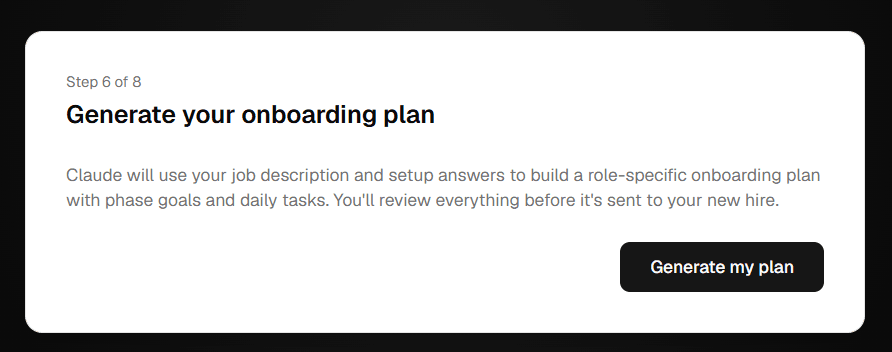
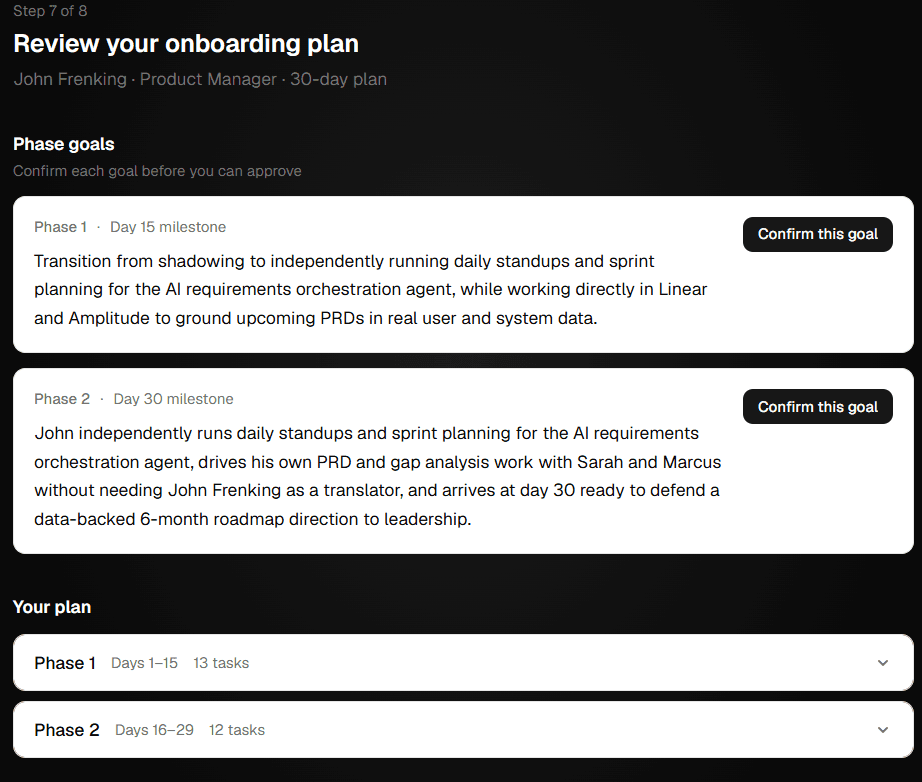
It starts with the knowledge the manager already has, a job description and a short guided questionnaire to pull best practices, resources, expectations, etc. and turns that into a real onboarding plan: phased goals, concrete tasks, and clear completion criteria, generated for the specific employee instead of pulled from a generic template. Starting Day 1, the new hire opens a workspace built around daily focused actions instead of a wall of tasks, aligned to their 30, 45, or 60 day ramp goals. When something isn't clear, an AI chatbot answers using their actual plan, their actual role, and their actual questions, moving past generic onboarding advice. On the other side, the manager gets a dashboard that shows real progress: which phase a new hire is in, what's been completed, where they might be falling behind; offering oversight without turning into a tool for watching someone's every move.
- Decision 1
Two structurally separate surfaces, not one app with roles.
Manager and new-hire experiences are distinct at the middleware, API, and database layers. These are separate by design, limiting manager visibility to task completion and phase progress, while a new hire has the freedom and privacy to learn and grow under the guidance of pre-populated tribal knowledge.
- Decision 2
The AI chat is grounded, not generic.
Every response is assembled server-side from the manager's actual setup answers, phase goals, tasks, and job description. Responses route through four tiers (In-plan, Role/company context, Adjacent (manager/human redirect), and Out-of-scope). From there, every message logs which tier fired without logging the content itself for privacy protection.
- Decision 3
30, 45, 60 day ramp phases account for role complexity.
When deciding what ramp period is actually beneficial to a new hire, I realized it varies by who would actually be using it. An SDR is productive by week two, so thirty days allows for a clear direction to be defined. A cross-functional lead is still building relationships and setting direction well past day forty-five, so that role needs the full sixty. Most IC roles, like a junior data scientist learning the team's tools and systems, land in between: enough time to do real work, not so much that the plan stops being actionable. Allowing the plans to fall across three genuinely different complexity classes opens the value of the tool to a broader scope of users.
App build phases are complete; it is now undergoing UI updates and final production testing before launch.